
Whether reading a book or searching online, you'll find the same basic information about Sarracenia purpurea. It's divided into two subspecies - purpurea and venosa - separated by geography. The northern plants, which encompass every plant north of about New Jersey, comprise subspecies purpurea and the southern plants, which encompass every plant south of about New Jersey, comprise subspecies venosa.
The dividing line between the two subspecies is blurry and most commentators rely on the following criteria (in addition to geographic location) to determine whether any given plant is subspecies purpurea or venosa:
1. The outer surface of the pitchers of the northern subspecies is smooth, whereas the outer surface of the pitchers of the southern subspecies is hairy.
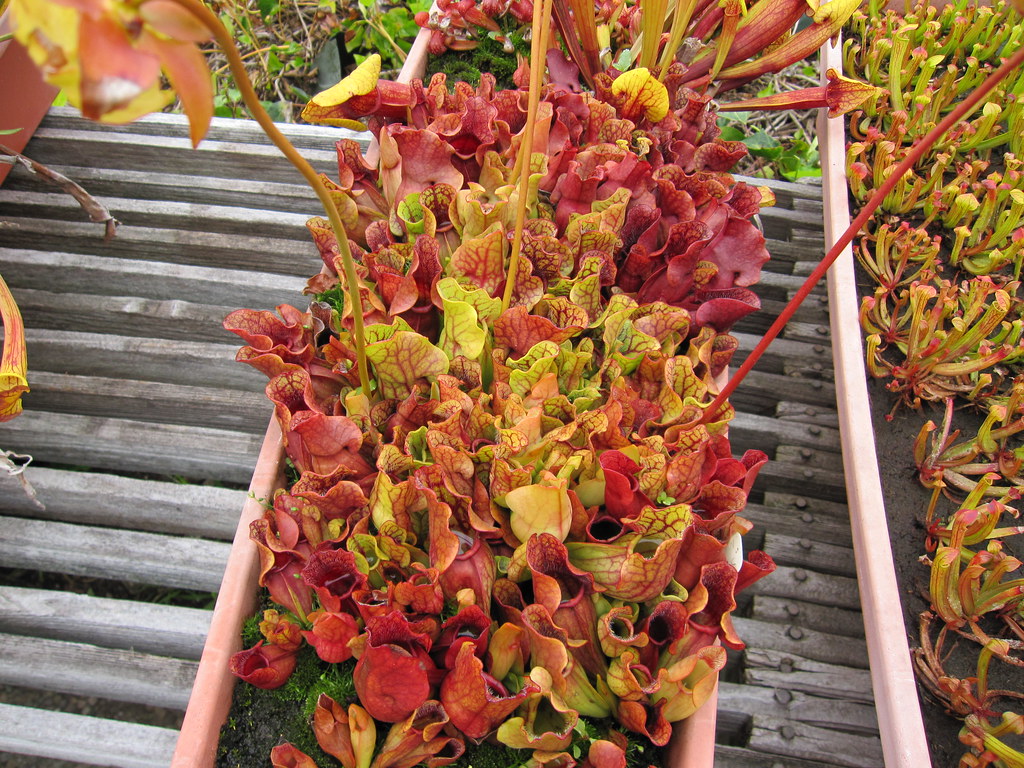
2. The hood of pitcher of the northern subspecies is smaller and, if the edges are pinched together, barely overlap. The hood of the pitcher of the southern subspecies undulates and easily overlaps.
3. The northern subspecies has pitchers which are 3x longer than the width of the pitcher mouth, while the southern subspecies has pitchers which are shorter.
4. The flowers of the northern subspecies are a darker red to reddish-purple.
 |
| Large Undulating Hoods |

 |
| Pitchers Less than 3x Longer Than Pitcher Mouth |
Thinking about the plants in cultivation, I'm under the impression that many Sarracenia purpurea subspecies purpurea in cultivation originate from Ontario and New York, but some can be found from Delaware and, of course, New Jersey. Many of the older, unlabeled plants, may actually come from the old Peter Paul's nursery in New York which was a nursery unscrupulously run by individuals who took a large number of plants from the wild. I don't believe many plants originate from Massachusetts or North in cultivation (likely due to lack of collection as well as the tendency for more northern plants to require longer, colder dormancies). So, it may be that these four criteria work very well for plants in cultivation, but they certainly don't apply* in the wilds of Northern New England.
*Note: I haven't said anything about flower color because I don't actually have any venosa - besides putative S. rosea plants - so I don't have anything to compare flower color to. The northern plants I've seen, besides the heterophylla, all have dark red/maroon flowers. I'm not sure how that compares to venosa.
No comments:
Post a Comment