
 |
| Thrips |
 |
| Someone else's N. ventrata with Thrips damage |
Thrips Life Cycle
The first step to successful Thrips treatment is understanding the life cycle of Thrips. Thrips lay their eggs inside plant tissue and the eggs themselves can take up to several weeks to hatch. Thus, it really isn't possible to "treat once and be done" as some commentators have erroneously stated. Instead, treatment must take place over several weeks. For my part, I usually isolate any new or possibly infected plant for around two months, just to be safe.Further, after the eggs hatch and the Thrips progress through their larval stage (where they eat the plant's sap), they enter the pupal stage. During the pupal stage, Thrips live in the media below the plant itself. As a consequence, it is very import to treat not only the plant with pesticide, but also the media itself.
 |
| Thrips damage on someone else's N. gymnaphora |
Thrips Damage
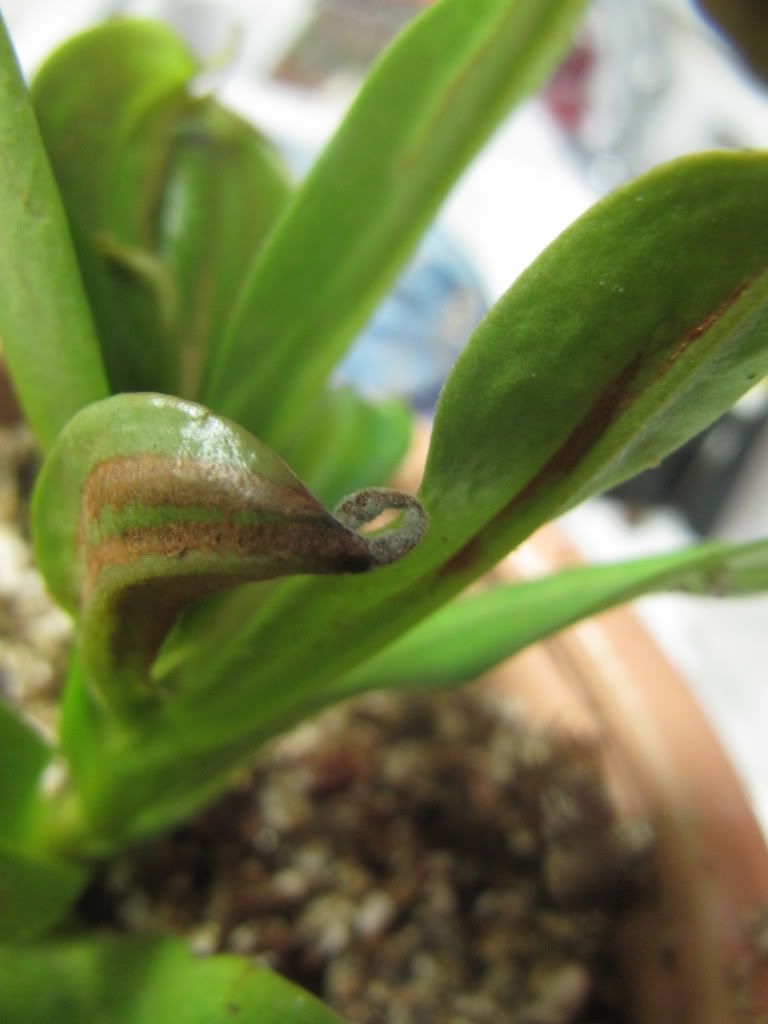
From observations on my own plants, I've most often seen seen leaves that look dessicated. They will often appear malformed instead of large and waxy. Brown streaks or spots will be evident. Often, an infected plant will not pitcher.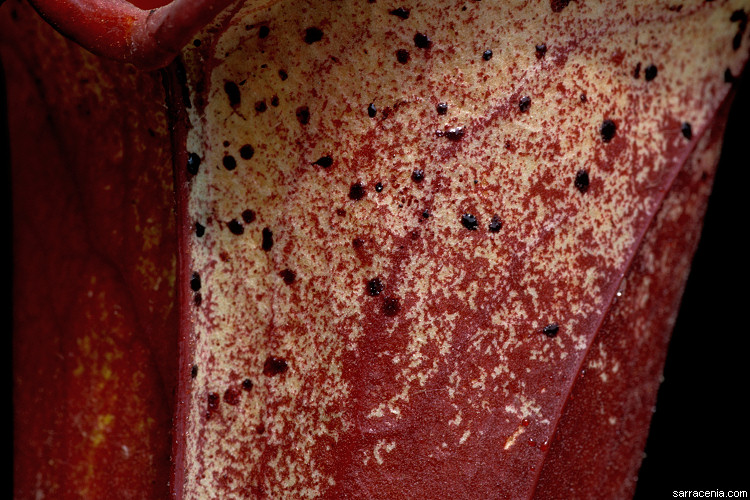 |
| Thrips damage and excrement on someone else's Sarracenia |
Identifying Thrips
Typicall, I usually notice thrips in their larval stage thanks to the damage they to a growing plant. In Nepenthes, I've seen new leaves grow with brown lines across them. This is, more often than not, the telltale sign. It is also possible to see the Thrips excrement, sometimes. (See brown spots in photo above). Generally, blowing across the leaf gently will result in the minute adults flying up.
 |
| Thrips on someone else's N. sanguinea |
Thrips Treatment
The Take-Away
Personally, I've found that Avid is the most effective pesticide. Others have reported success with using Orthene. (I did not have similar success). Obviously, you'll have to follow the directions on the bottle of poison you choose, but, generally, you'll have to treat the plants once a week for four-to-five weeks.
One thing to note is that some plants are particularly sensitive to treatments. For instance, Nepenthes dubia and its hybrids and Nepenthes hamata and its hybrids respond quite poorly to Avid treatment. If it is possible, I find that it is better to isolate plants individually and treat them individually in order to monitor each plant's individual situation.
The Take-Away
- Prevention is best. Isolate new plants from the rest of your collection for at least three weeks.
- Pests in my indoor collection have all come from infected plants I recently acquired. As such, I highly recommend isolating your new plant acquisitions. I now isolate every plant I acquire. My set-up involves numerous 10-gallon terrariums and the occasional (Zip-Loc) plastic bag.
- Vigilance is key. Frequently inspect your plants for signs of infection.
- Note any growth or plant death that seems odd. If a plant is behaving strangely, check it every day to monitor its situation. As soon as you suspect Thrips (or another pest) isolate that plant.
- If a new plant from Source A shows signs of infection, the other plants from Source A will also get treated as a preventative measure.
- Treat plants as soon as you see signs of infection.
Thrips damages pants in a very core way ,we have to learn about how can we prevent from Thrips and protect our plants from diseases.
ReplyDelete